Tax Consultancy
(Professional advice for your business)
Direct and Indirect Taxation

Taxation & GST Services
Expert Taxation Solutions for Businesses & Individuals
At J M A & Co., we provide comprehensive taxation and GST advisory services tailored to meet the dynamic needs of businesses and individuals. Our expertise ensures compliance, efficiency, and strategic tax planning to help you optimize your tax liabilities while adhering to legal frameworks.
Our Taxation Services
1. Income Tax Advisory & Compliance
- Tax return preparation and filing for individuals, firms, and companies
- Tax planning strategies to minimize liabilities
- Handling notices, assessments, and appeals
- TDS/TCS compliance and return filing
2. Corporate & Business Taxation
- Corporate tax planning and compliance
- Advance tax computation and filing
- Representation before tax authorities
- Tax audits as per statutory requirements
GST Services – Ensuring Seamless Compliance
1. GST Registration & Compliance
- GST registration for businesses, startups, and professionals
- Periodic GST return filing (GSTR-1, GSTR-3B, GSTR-9, etc.)
- E-invoicing and E-way bill compliance
2. GST Advisory & Litigation Support
- GST input tax credit (ITC) optimization
- GST impact analysis on transactions and pricing
- Handling GST audits, scrutiny, and notices
- Representation before GST authorities
Why Choose J M A & Co.?
- Experienced Chartered Accountants & Tax Professionals
- Timely and accurate tax compliance
- Strategic tax-saving solutions
- Personalized client support and representation

GST Consulting & Implementation
At J M A & Co., we provide expert GST Consulting and Implementation services designed to help businesses navigate the complexities of GST and related tax systems. Our goal is to enable businesses to operate in the most tax-efficient manner while ensuring full compliance with local and international tax regulations.
Our GST Consulting Services
- GST Impact Assessment: Analyze the effect of GST on your business operations and financial performance while identifying opportunities for optimization.
- Tax-Efficient Business Structuring: Design a structure that maximizes Input GST utilization and ensures timely refunds, in compliance with Federal Tax Authorities (FTA).
- Compliance with Local and International Tax Laws: Provide guidance on local and international tax regulations, including GST, Excise Tax, and other indirect taxes.
- Implementation and Ongoing Support: Assist with GST system implementation, filing, reporting, and ongoing regulatory updates.
Key Features of Our GST Services
- Utilization and Refund of Input GST: Ensure your business fully leverages Input GST credits and receives timely refunds to enhance cash flow.
- Guidance on Tax Regulations: Stay updated with the latest changes in GST, Excise Tax, and indirect tax laws across various jurisdictions.
Benefits of Partnering with J M A & Co.
- Tax Efficiency: Minimize tax liabilities and improve cash flow through effective GST management.
- Regulatory Compliance: Ensure full compliance with Federal Tax Authority (FTA) requirements and local tax laws.
- Customized Solutions: Tailor tax strategies to your business needs and industry requirements.
- Global Expertise: Leverage our extensive knowledge of international taxation and indirect tax regulations to support cross-border operations.
- Proactive Support: Stay ahead of regulatory changes with timely updates and expert guidance.
At J M A & Co., we are committed to simplifying the complexities of GST and indirect taxes for your business, ensuring compliance while optimizing tax efficiency and operational performance.
Impact of GST on your business
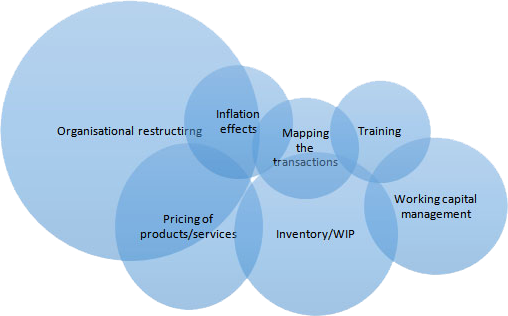
How We Help You Devise a GST Plan
At J M A & Co., we specialize in creating tailored GST plans that address your business’s unique needs and ensure seamless compliance with GST laws. Our process is structured to help your organization effectively manage GST-related challenges while optimizing tax efficiency and maintaining compliance.
1. Business Structure Analysis
- Conduct a comprehensive review of your company’s existing business structure.
- Identify aspects of the business that may be impacted by GST laws, including procurement, supply chain, invoicing, and pricing strategies.
2. Classification and Segregation of Transactions
- Categorize your company’s operations into local, interstate, and foreign transactions.
- Evaluate the GST implications of each type of transaction to provide clarity and actionable insights.
- Review existing contracts to ensure they align with GST requirements and provide recommendations for amendments where necessary.
- Assist in recovering Input Tax Credits by ensuring proper documentation and compliance with recovery rules.
3. GST Registration Assistance
- Guide your company in understanding the mandatory and voluntary registration requirements under GST law.
- Assist in preparing and submitting the documents required for registration to obtain a GST Registration Number.
- Provide clarifications and submit additional documentation as requested by GST authorities during the registration process.
4. GST Software Review and Optimization
- Review OUTPUT and INPUT data from your implemented GST software to ensure accuracy and compliance.
- Suggest modifications or improvements in the software configuration to meet regulatory requirements and optimize tax management.
5. GST Compliance and Tax Returns
- Assist in the preparation and submission of GST-compliant tax returns, including GSTR-1, GSTR-3B, and others as applicable.
- Ensure accurate and timely filing of returns to avoid penalties and maintain compliance.
- Provide ongoing support to address compliance issues and manage any queries raised by authorities.
At J M A & Co., we are committed to helping your business navigate GST complexities effectively while optimizing operational efficiency and tax benefits.
Overview of GST Return Forms in India
Goods and Services Tax (GST) in India mandates the filing of various return forms to report sales, purchases, tax liabilities, and credits. These forms vary by taxpayer type (e.g., regular, composition scheme, non-residents) and transaction nature. As of 2025, key updates include a three-year filing deadline for certain returns and non-editable auto-populated fields in GSTR-3B from July 2025. Below is a summary of the purpose of each major GST return form, presented in a table for clarity. Suspended forms (e.g., GSTR-2, GSTR-3, GSTR-9A) are noted separately at the end.
|
Form |
Purpose |
Applicability and Filing Frequency |
|
GSTR-1 |
Reports details of all outward supplies (sales) of goods and services, including invoices, debit/credit notes, and amendments to previous periods. Serves as the source for auto-populating buyers' input tax credit (ITC). |
All normal registered taxpayers (including casual taxable persons). Monthly by 11th (turnover > ₹5 crore) or quarterly by 13th (QRMP scheme opted). |
|
GSTR-1A |
Allows amendments to GSTR-1 details for the same tax period before finalizing GSTR-3B. |
Normal taxpayers filing GSTR-1. Filed after GSTR-1 but before GSTR-3B. |
|
GSTR-2A |
View-only dynamic reconciliation statement of inward supplies (purchases) auto-populated from suppliers' GSTR-1. Used to verify and claim accurate ITC. |
All registered recipients/buyers. Auto-generated monthly; no filing required. |
|
GSTR-2B |
View-only static monthly snapshot of eligible ITC from inward supplies, based on suppliers' filings up to the previous month. Helps in claiming ITC before GSTR-3B and identifying discrepancies. |
All registered recipients/buyers. Available by 12th of each month; no filing required. |
|
GSTR-3B |
Self-declared summary of outward supplies, ITC claimed, tax liability, and taxes paid. Reconciles with GSTR-1 and GSTR-2B for compliance. |
All normal registered taxpayers. Monthly by 20th (turnover > ₹5 crore) or quarterly by 22nd/24th (QRMP scheme). |
|
GSTR-4 |
Annual summary of outward supplies and tax payments under the composition scheme. Replaces the earlier GSTR-9A. |
Composition scheme taxpayers (turnover up to ₹1.5 crore for goods/₹50 lakh for services). Annually by 30th April. |
|
GSTR-5 |
Reports outward/inward supplies, debit/credit notes, tax liability, and payments for non-resident foreign taxpayers. |
Non-resident taxable persons. Monthly by 20th. |
|
GSTR-5A |
Summarizes outward taxable supplies and tax payable by Online Information and Database Access or Retrieval (OIDAR) service providers. |
OIDAR providers (non-residents). Monthly by 20th. |
|
GSTR-6 |
Details input tax credit received and distributed to branches/units, including distribution documents. |
Input Service Distributors (ISDs). Monthly by 13th. |
|
GSTR-7 |
Declares tax deducted at source (TDS), liability, payments, and any refunds claimed. |
TDS deductors under GST (e.g., government entities). Monthly by 10th. |
|
GSTR-8 |
Reports supplies facilitated through e-commerce platforms and tax collected at source (TCS). |
E-commerce operators collecting TCS. Monthly by 10th. |
|
GSTR-9 |
Annual consolidation of all outward/inward supplies, taxes paid, and HSN-wise summaries from monthly/quarterly returns. Ensures overall compliance for the financial year. |
Regular taxpayers (mandatory if turnover > ₹2 crore; optional below). Annually by 31st December. |
|
GSTR-9C |
Self-certified reconciliation between audited financial statements and GSTR-9, including adjustments and certifications. |
Taxpayers with turnover > ₹5 crore. Annually by 31st December (same as GSTR-9). |
|
GSTR-10 |
Final return to report remaining stock, liabilities, and payments after registration cancellation or surrender. |
Taxpayers whose GST registration is cancelled/surrendered. Within 3 months of cancellation. |
|
GSTR-11 |
Reports inward supplies and claims refunds on taxes paid for untaxed entities like embassies. |
Persons with Unique Identity Number (UIN), e.g., foreign diplomatic missions. Monthly by 28th. |
|
CMP-08 |
Quarterly statement-cum-challan for tax payments under composition scheme. |
Composition scheme taxpayers. Quarterly by 18th of the succeeding month. |
|
ITC-04 |
Declares details of goods sent for job work, received back, or lost/rejected, for ITC eligibility. |
All registered taxpayers sending goods for job work. Half-yearly/annually by 25th October/April (varies by turnover). |
Suspended/Discontinued Forms
- GSTR-2: Inward supplies reporting (suspended since September 2017; auto-populated but editable).
- GSTR-3: Monthly consolidated summary return (suspended since September 2017).
- GSTR-9A: Annual return for composition taxpayers (scrapped from FY 2019-20; replaced by GSTR-4).
GST: Some Key Highlights
What is GST in India?
The Goods and Services Tax (GST) is a comprehensive, destination-based indirect tax system that has replaced many indirect taxes in India, such as excise duty, VAT, and service tax. GST was implemented on 1st July 2017, following the passage of the GST Act in Parliament on 29th March 2017.
GST is levied on the supply of goods and services at every stage of the supply chain, ensuring uniform taxation across the country. It simplifies India’s indirect tax system by consolidating multiple taxes into a single law.
Key Features of GST
1. Multi-Stage Tax
GST is applied at every stage of the supply chain, from the purchase of raw materials to the final sale to the consumer.
- Purchase of raw materials
- Production or manufacturing process
- Warehousing of finished goods
- Selling to wholesalers
- Sale of products to retailers
- Final sale to end consumers
2. Value Addition
GST is levied only on the monetary value added at each stage of the supply chain.
- Example: A biscuit manufacturer buys raw materials like flour and sugar, converts them into biscuits, and sells them to a warehousing agent who packages them. Each stage adds value to the product, and GST is charged only on the value addition at each stage.
3. Destination-Based Tax
GST is collected at the point of consumption, not origin.
- Example: If goods are manufactured in Punjab and sold to a consumer in Himachal Pradesh, the tax revenue will go to Himachal Pradesh, the place of consumption.
Benefits of GST
- Eliminates cascading taxes by allowing input tax credits.
- Creates a uniform tax structure across the country.
- Simplifies compliance by consolidating multiple taxes.
- Encourages formalization of the economy.
- Boosts economic growth by streamlining taxation.
We are Chartered Accountants
*Business and Tax Consultants*
Specialize in helping small and medium-sized enterprises (SMEs) create sustainable growth through successful expansion into international markets.
Download Firm Profile